
 Hailey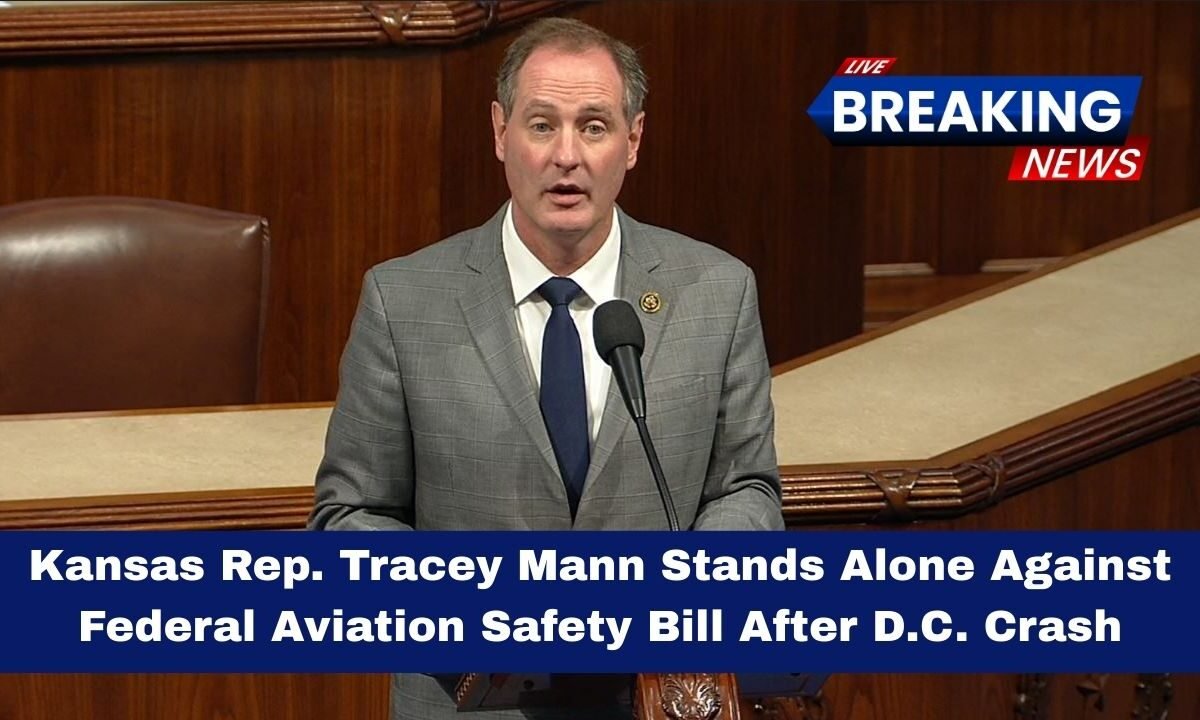
In a critical moment for U.S. aviation policy, U.S. Representative Tracey Mann, a Republican from Kansas’ 1st Congressional District, became the only member of the Kansas delegation to vote against a major federal aviation safety bill.
The legislation, known as the ROTOR Act, was prompted by the tragic January 29, 2025 mid-air collision near Washington, D.C., which claimed the lives of 67 people. While the bill passed the U.S. Senate unanimously, it failed in the House of Representatives by just one vote, largely due to Mann’s opposition.
Background: The 2025 Mid-Air Collision

On January 29, 2025, an American Airlines regional jet departing from Wichita, Kansas collided with a U.S. Army Black Hawk helicopter near Ronald Reagan Washington National Airport.
The crash occurred at approximately 300 feet altitude and resulted in 67 fatalities. This tragedy exposed critical gaps in aviation safety and spurred urgent calls for stronger federal oversight.
Provisions of the ROTOR Act
The ROTOR Act was designed to prevent future accidents and included several key measures:
- Mandatory tracking technology: Most aircraft would be required to install Automatic Dependent Surveillance-Broadcast (ADS-B) systems for improved situational awareness.
- Flight route safety reviews: The FAA would conduct regular safety evaluations of operations at major airports.
- Military coordination: Provisions addressed operational and security concerns for military aircraft.
House Vote Outcome
The ROTOR Act required a two-thirds majority to pass in the House on a fast-track vote. The final tally was:
| Item | Detail |
|---|---|
| Aviation safety bill | ROTOR Act |
| Purpose | Enhance aviation safety and prevent mid-air collisions |
| Trigger event | January 29, 2025 crash near D.C. |
| Fatalities | 67 people |
| Senate vote | Passed unanimously |
| House vote | 264–133 (failed, needed two-thirds majority) |
| Lone opposition (Kansas) | Rep. Tracey Mann |
| Tracking technology | ADS-B systems |
| Future prospects | Possible new vote or alternative legislation |
Among Kansas‘ six congressional members, Tracey Mann was the only lawmaker to vote against the bill. His opposition was pivotal in the House vote failing by a single vote.
Reactions from Lawmakers and Advocates
The narrow failure prompted strong responses from other lawmakers:
- Rep. Sharice Davids emphasized the need for continued aviation safety reforms.
- Rep. Ron Estes highlighted the importance of advanced tracking systems to prevent future tragedies.
- Aviation safety advocates are urging a new vote or alternative legislation that addresses gaps identified in the 2025 crash.

Critics noted that military concerns and costs contributed to opposition and the bill’s defeat in the House.
The ROTOR Act’s narrow failure underscores the challenges of updating federal aviation safety standards after a major tragedy. Tracey Mann’s lone vote against the measure highlights the political and procedural complexities involved in passing critical safety reforms.
Continued advocacy from lawmakers and aviation safety experts may yet lead to strengthened protections and safer air travel in the United States.