
 Mandy
Mandy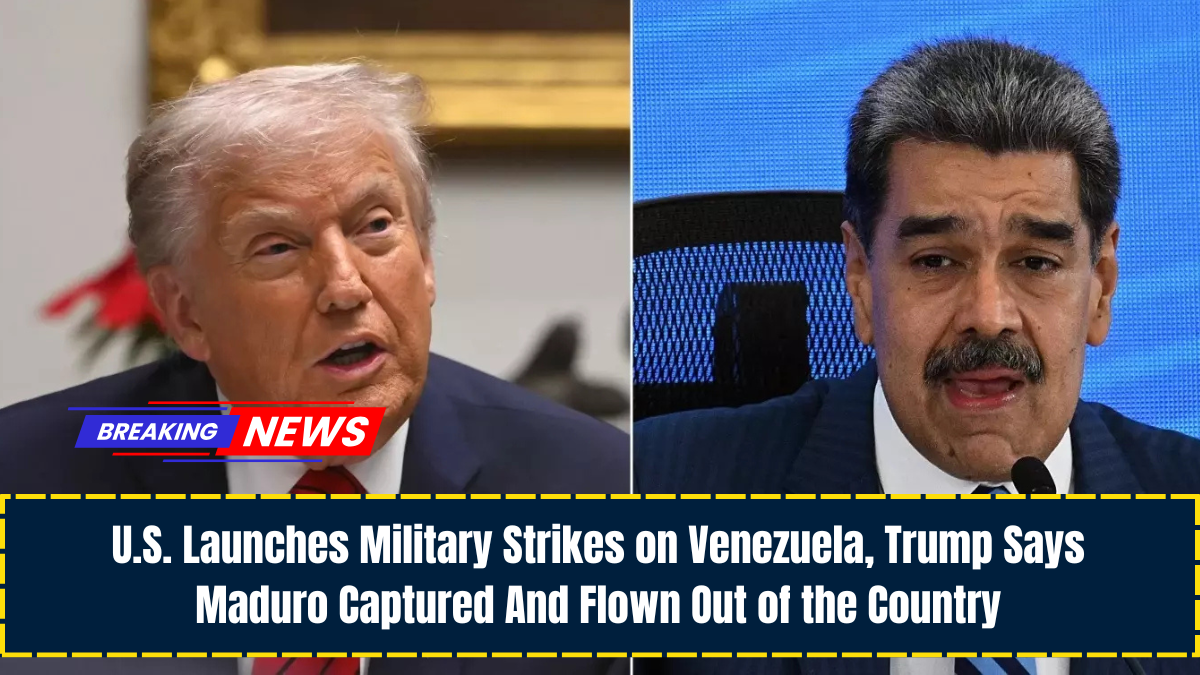
The United States carried out a large-scale military operation in Venezuela early Saturday, with President Donald Trump announcing that Venezuelan President Nicolás Maduro and his wife were captured and flown out of the country.
Reports of explosions in Caracas and other areas quickly followed, signaling a major escalation after months of rising tensions between Washington and Caracas.
What Triggered the U.S. Military Action

According to U.S. officials cited by CBS News, the operation was conducted by the U.S. Army’s Delta Force, one of America’s most elite special operations units.
Their mission was to execute an arrest warrant against Maduro, who has been indicted in the United States since 2020 on charges related to narco-terrorism.
President Trump confirmed the operation on Truth Social, stating that U.S. forces had successfully completed the mission and that American law enforcement agencies were involved, though he did not identify which ones.
A formal press conference was scheduled at Mar-a-Lago later in the day to provide further details.
Months of Military Buildup in the Caribbean
The strikes did not come without warning signs. Over recent months, the U.S. significantly expanded its military presence in the Caribbean, including the deployment of the USS Gerald R. Ford aircraft carrier along with several additional warships.
In the weeks leading up to the operation, the U.S. also:
- Seized two oil tankers linked to Venezuela
- Launched strikes on more than 30 boats, which U.S. officials claimed were involved in drug trafficking
- Targeted dock areas allegedly used to load narcotics for export
The Trump administration has long accused Maduro of working with drug cartels and gangs designated as terrorist organizations, claims that Venezuela has consistently denied.
Maduro’s Arrest and the $50 Million Bounty
Maduro had been one of the most wanted foreign leaders by U.S. authorities. In March 2020, a U.S. court indicted him and several senior officials, accusing them of collaborating with Fuerzas Armadas Revolucionarias de Colombia (FARC) to move cocaine and weapons into the United States.
Last year, the Trump administration raised the reward for information leading to Maduro’s capture to $50 million. Prosecutors also alleged that he led a group known as Cártel de Los Soles, which the U.S. later designated as a foreign terrorist organization, though some analysts argue the group is loosely defined rather than centrally organized.
U.S. Officials Signal No Further Military Action
Shortly after the strikes, Republican Senator Mike Lee of Utah said Secretary of State Marco Rubio informed him that no additional military action in Venezuela is expected.
According to Lee, Rubio said Maduro is now in U.S. custody and will be brought to trial on criminal charges. The military action, he added, was strictly intended to protect personnel executing the arrest warrant.
Venezuela Demands Proof of Life
Inside Venezuela, confusion and uncertainty followed. Vice President Delcy Rodriguez appeared on state television demanding proof that Maduro is alive and confirmation of his location.
At the same time, Defense Minister Vladimir Padrino López announced that military forces were being deployed nationwide, calling the U.S. strikes “the worst aggression” Venezuela has ever faced.
He urged citizens to remain calm, warned against disorder, and confirmed that the government declared a state of emergency, referred to as a “state of external commotion.”
U.S. Warns Americans to Shelter in Place
As the situation unfolded, the U.S. State Department issued an urgent notice advising American citizens in Venezuela to shelter in place. Officials said the U.S. Embassy in Bogotá was monitoring reports of explosions in and around Caracas.
The U.S. has repeatedly warned against travel to Venezuela, citing risks including arbitrary detention, kidnapping, terrorism, civil unrest, and poor health infrastructure.
The U.S. military strikes on Venezuela and the reported capture of Nicolás Maduro mark one of the most dramatic moments in U.S.–Latin American relations in decades.
With Maduro now allegedly in U.S. custody, Washington says its objective has been met, while Venezuela’s leadership disputes the claims and mobilizes its forces.
As global attention turns to the promised U.S. briefing and possible legal proceedings, the situation remains tense, uncertain, and closely watched by the international community.